
NEWS & INSIGHTS
Stay Informed. Keep Moving.
Related Posts
- ▶ First vs. Second Generation Wheel Hub Bearings: Installation Differences
- ▶ Second Generation Wheel Hub Bearings: Design and Mounting Explained
- ▶ Automotive AC Compressor Bearings: How Heat and Speed Affect Service Life
- ▶ First Generation Wheel Hub Bearings: Design and Installation Basics
- ▶ Why Do Wheel Hub Bearings Fail? Common Causes and Diagnostic Signs
- ▶ Selecting Tapered Roller Bearings for Combined Radial and Axial Loads
Send Us A Message
Selecting Tapered Roller Bearings for Combined Radial and Axial Loads
Tapered roller bearings are a practical choice when a shaft must carry radial and axial loads at the same time. But the correct bore and outside diameter are only a starting point. The bearing arrangement must also accommodate the direction of thrust, the actual load cycle, operating speed, lubrication, and changes in internal clearance as the machine warms up.
Begin with the loads and shaft support arrangement, then narrow the options by size. A bearing that fits the housing but cannot control axial movement in both required directions is not a suitable replacement.
Start with the load in each operating condition
Radial load acts across the shaft, while axial load acts along it. Consider both during normal running, startup, braking, reversing, and any foreseeable overload. A gearbox output shaft, for example, may experience a different thrust direction when torque reverses. Selecting from the normal operating load alone can miss the condition that governs bearing life or shaft movement.
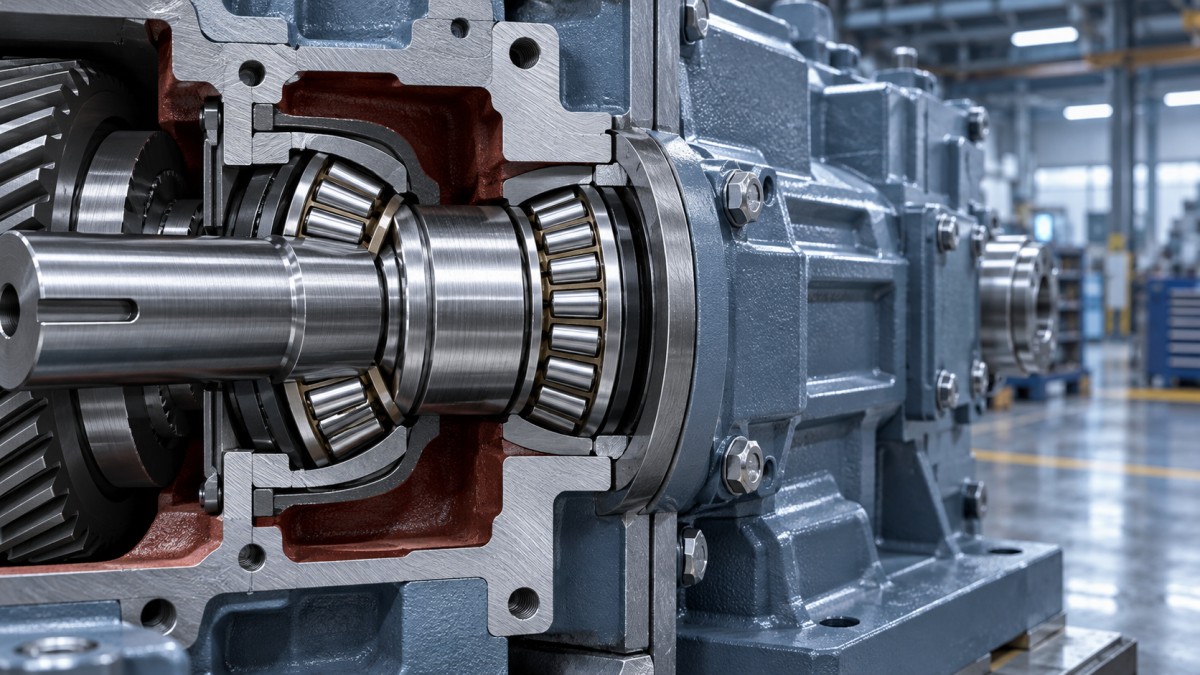
A single-row tapered roller bearing supports axial load in one direction. It also develops an axial reaction under radial load, so it normally needs an opposing bearing or another suitable means of axial location. For thrust in both directions, an opposed pair or a suitable double-row arrangement may be appropriate. The choice depends on the available space, required stiffness, assembly method, and how the shaft must be located.
When comparing candidates, use the bearing manufacturer’s calculation method for equivalent dynamic load and rating life. Include the load sharing between bearings, rather than assuming each bearing carries the same load. Where shock loads or long stationary periods matter, check static load capacity as well; a satisfactory calculated fatigue life does not by itself rule out permanent deformation.
Choose an arrangement that controls movement
Two single-row bearings are often mounted in opposition. In a back-to-back arrangement, their effective load lines diverge outward, giving a wider effective support spread that can help resist overturning moments. In a face-to-face arrangement, the lines converge, giving a narrower effective spread and generally greater tolerance of misalignment. Neither arrangement eliminates the need to assess shaft deflection and housing alignment.
Internal clearance or preload must be set for the complete assembly. Preload can improve stiffness and control shaft position, but excessive preload increases friction and heat and can shorten bearing life. Excessive clearance, on the other hand, can allow unwanted movement and uneven load distribution. Shaft and housing fits, component temperatures, and thermal expansion can all change the setting after installation. Specify the setting for the operating arrangement, not just for a bearing measured on a bench.
Check speed, lubrication, and contamination together
Compare the required operating speed with the applicable bearing speed guidance, taking account of load, lubrication, cooling, and preload. A bearing that meets the load calculation may still run too hot at the intended speed. If speed or friction is the dominant constraint and axial load is modest, another bearing type may be a better fit for the assembly.
Lubricant must reach the rolling contacts and remain suitable at the operating temperature. Oil can support circulation and heat removal where the machine design allows it; grease may simplify retention and maintenance in other arrangements. Seal selection matters too: contamination can damage rolling surfaces, while restrictive seals can add friction. Assess the bearing, lubricant, seals, and maintenance interval as one system.
Match the replacement beyond its dimensions
Before sourcing a bearing, record the existing designation and check the shaft and housing fits, available space, mounting orientation, and adjustment method. Bearings with matching principal dimensions are not automatically interchangeable: internal geometry, load ratings, tolerances, and compatible mating components can differ. For a cup-and-cone assembly, identify both components and establish whether they are supplied and matched as required for the application.
A useful inquiry includes the radial and axial load cases, speed range, required life, operating temperatures, lubricant, expected contamination, and any limits on shaft movement. Share drawings and the existing bearing references where available. These details allow the bearing arrangement and operating setting to be evaluated together, instead of treating the part number as the entire specification.
- Last One:No more articles
- Next Article:No more articles