
NEWS & INSIGHTS
Stay Informed. Keep Moving.
Related Posts
- ▶ First vs. Second Generation Wheel Hub Bearings: Installation Differences
- ▶ Second Generation Wheel Hub Bearings: Design and Mounting Explained
- ▶ Automotive AC Compressor Bearings: How Heat and Speed Affect Service Life
- ▶ First Generation Wheel Hub Bearings: Design and Installation Basics
- ▶ Why Do Wheel Hub Bearings Fail? Common Causes and Diagnostic Signs
- ▶ Selecting Tapered Roller Bearings for Combined Radial and Axial Loads
Send Us A Message
Automotive AC Compressor Bearings: How Heat and Speed Affect Service Life
Heat and rotational speed affect automotive AC compressor bearing life together: higher speed can increase frictional heat, while higher temperature can weaken the lubricant film that separates rolling surfaces. A bearing that meets a speed rating under catalog conditions may still have a short service life if its installed temperature, load, fit, or lubrication differs from those conditions.
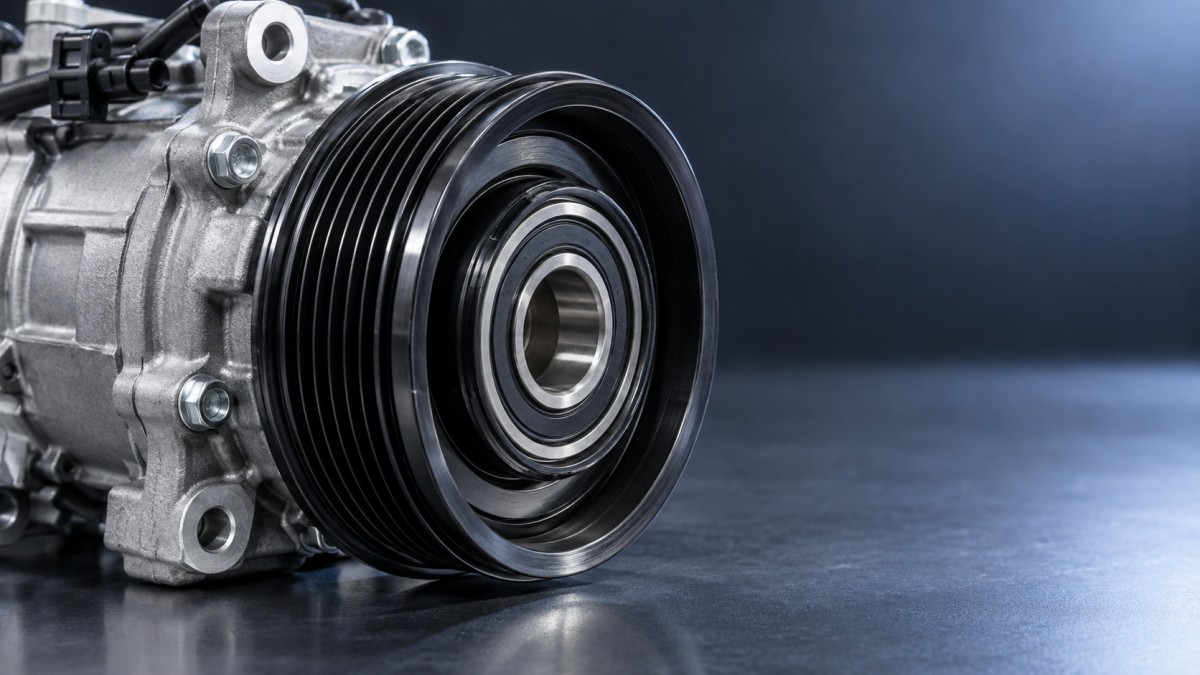
For technical evaluation, the first task is to identify which bearing is being assessed. In a belt-driven compressor with an electromagnetic clutch, the pulley bearing can rotate whenever the engine runs, including when the compressor is disengaged. Internal compressor bearings have a different duty cycle and lubrication environment. Their temperatures, speeds, and failure mechanisms should not be treated as interchangeable.
How Heat Changes Bearing Conditions
Lubricant condition is often the limiting concern. As bearing temperature rises, grease can oxidize more quickly, its oil can become less effective at maintaining a separating film, and seals may lose effectiveness. Once lubrication deteriorates, metal-to-metal contact can increase friction and temperature further. The result may be noise, roughness, wear, or seizure, depending on the bearing and the severity of the damage.
Temperature also changes the installed clearance. The inner ring, outer ring, shaft, and housing do not necessarily expand by the same amount or at the same rate. Depending on the materials, fits, and heat flow, operating clearance can decrease enough to increase internal loading, or become excessive and impair load distribution. The clearance measured before installation therefore does not, by itself, establish the clearance during operation.
For a sealed pulley bearing, the grease and seal must be suitable for the temperature reached at the bearing, not just the surrounding air temperature. Heat can come from the compressor, clutch operation, belt drive, and nearby engine components. A short peak and a sustained high temperature can have different consequences, so both duration and frequency matter.
Speed Raises More Than a Catalog Question
As speed increases, rolling-element and cage motion can generate more frictional heat. Lubricant behavior, seal drag, load, and the bearing’s ability to dissipate heat all affect the resulting temperature. A higher catalog speed limit can be useful for screening, but it does not guarantee acceptable life in a particular compressor assembly: the rating is tied to stated assumptions, and the installed bearing may operate under different conditions.
Use bearing speed, not engine speed alone, when assessing a belt-driven pulley. Pulley ratio determines the relationship between them, and the duty cycle determines how long the bearing remains at each speed. For an internal bearing, establish the compressor shaft speed and lubrication conditions for the specific design.
High temperature and high speed do not have to occur continuously to matter. Repeated operation near the upper end of the duty cycle can accelerate lubricant degradation, while heat soak after shutdown may expose a stationary bearing and its seals to elevated temperatures. An evaluation based only on a steady operating point can miss either condition.
What to Check in an Evaluation
Start with the bearing location and build a duty profile around the installed assembly. The following information makes comparisons more meaningful:
- Speed and time: bearing speed across the operating range, time spent at high speed, and whether the pulley rotates while the compressor is disengaged.
- Temperature exposure: measured or representative bearing temperatures during operation and after shutdown, including peak duration and repeated cycles.
- Loads and fit: belt tension and alignment for pulley bearings, shaft and housing fits, and the resulting operating clearance.
- Lubrication and sealing: grease suitability and seal capability for a sealed bearing, or the applicable lubricant environment for an internal bearing.
- Rating conditions: the load, lubrication, temperature, and mounting assumptions behind any life or speed rating used for comparison.
Fatigue-life calculations are useful when their load and speed inputs are representative, but they do not automatically predict failures caused by grease degradation, contamination, poor fit, or seal damage. Likewise, a higher temperature rating for grease alone does not establish the operating limit of the complete bearing assembly.
When investigating a failed bearing, distinguish evidence of lubricant or seal deterioration from damage associated with mounting, misalignment, or excessive belt load. These causes can interact: an unfavorable fit, for example, may raise internal load and temperature before lubrication fails. The strongest comparison between bearing options uses the same installed conditions and examines both temperature behavior and bearing condition over the relevant duty cycle.
- Last One:No more articles
- Next Article:No more articles